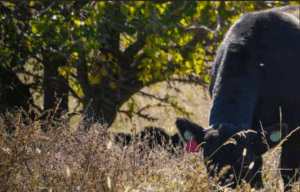

Stocking rate is the fundamental management factor under producer control that has a major impact on animal performance, producer profitability, and long-term sustainability of native range production systems.
As stocking rate increases, average daily gains decrease. T
his is due to increased competition for preferred herbage among individuals and subsequently reduced diet quality.
Yet, as stocking rates increase, total bodyweight gain per acre increases up to the point that daily gains become so gain per acre also declines.
Generally, the influence on animal performance is much less when moving from a light to moderate stocking rate compared with moving from a moderate to heavy stocking rate.
Economic returns in grass-based operations on rangelands typically increase with heavy grazing intensity, defined as use of 50 to 55% of available forage, but that comes along with increased financial risk and susceptibility to drought and other adverse climatic events compared with moderate use (40 to 45% forage use).

Stocking density is often confused with stocking rate.
Stocking rate refers to the number of animals per unit of land over a period of time.
Stocking density is the number of animals on a pasture area at any one time and is an instantaneous measurement of the animal to land area relationship.
In continuous grazing management, stocking rate and stocking density may be the same.
Stocking density differs from stocking rate when the pasture is subdivided into paddocks and livestock are concentrated into the subdivided area.
In the early 90s, a 7-year experiment was initiated with stocker steers grazing through the summer on mixed grass native prairie at the Oklahoma State University Marvin Klemme Range Research Station in western Oklahoma (publication available at https://doi. org/10.1093/tas/txaa134).
Stocking rates ranged from 10 acres per steer (0.1 steers per acre) down to 4.5 acres per steer (0.22 steers/acre) for grazing seasons lasting from April through September.
Steers at the lowest stocking rate (10 acres per steer) gained an average of 1.85 pounds per day without supplementation throughout the summer while steers stocked at the highest stocking rate (4.5 acres per steer) gained 1.65 pounds per day.
Even with this reduction in steer performance, the total gain per acre and net return per acre more than doubled as stocking rates increased from 10 acres per steer to 4.5 acres per steer.
Over the 7-year period this research was conducted, the average precipitation during the growing season was 118% of the historical average and there was no effect of the increasing stocking rates on range condition or forage production.
The ideal growing conditions during this study may not have allowed for capturing changes in rangeland vegetation cycles through wet and dry years.

Research with beef cows grazing an introduced warm-season perennial bermudagrass forage base compared performance and economics of continuous grazing at a moderate stocking rate versus rotational grazing at a similar stocking rate or a higher stocking rate of twice the moderate stocking rate (available at https://doi.org/10.2527/jas.2016-0634).
When cows were stocked at the moderate rate, integration of rotational grazing management by dividing the land area into 6 paddocks resulted in decreased weaning weights per calf by 22 pounds at the moderate stocking rate and by 40 pounds at the high stocking rate.
Increasing stocking density reduces the potential for livestock to select the highest quality diet and leads to lower production even when stocking rates for the entire pasture remain unchanged.
Research at USDA Southern Plains Experimental Range was conducted to compare supplementation programs for steers grazing these mixed grass prairies.
Steers were either fed distillers grains based cubes only during the late summer at 2.5 pounds per day to offset reduced forage quality during the late summer at a moderate stocking rate of 6 acres per steer or steers were fed all summer at 0.75% of bodyweight (4.1 lbs/day for a 550 pound steer) with stocking rates increased by 1/3 (4 acres per steer).
Supplementation during the late summer at the moderate stocking rate increased gains by over 1 pound per day from 1.8 lb/day to 2.9 lb/day.
Feeding supplements all summer to calves with increased stocking rates increased daily gains compared with unsupplemented controls.
Total gain per acre was doubled by increasing stocking rates and feeding higher rates of supplements when compared to unsupplemented calves and increased gain per acre by 65 to 74% compared to supplementing steers only during the late summer at normal stocking rates.
Supplemental feeding can offset the reduced performance that comes with increasing stocking density, but the economic relationship between the value of the calf’s gain and the cost of the inputs must be considered.

Stocking rate impacts not only animal production potential but also short- and long-term forage production.
Thus, stocking rates impact not only the short- and long-term economics of the ranch but also range condition, long-term sustainability, and other ecosystem services such as wildlife habitat.
The desire to maintain future herbage production is significant to producers utilizing native rangeland especially since heavier stocking rates decrease future herbage production potential in western Oklahoma.
Using higher stocking rates during times of drought is even more detrimental to animal performance than conservative stocking rates and increases the risk to producers because of the greater financial losses from destocking.
Maintaining adequate residual herbagemass on native rangelands not only protects the landscape from both water and wind erosion but also provides escape cover for wildlife, improves water infiltration, and sustains herbage production potential for following years.
Producers are under significant economic pressures to maximize production per acre in an effort to maximize returns, which can prove harmful to rangeland condition, where preferred forage species are overgrazed and decline in the sward.
Increasing stocking rates also increases the variability of performance, increasing production risk on ranches with heavy forage utilization due to increased risk of destocking or feeding when drought conditions occur.
 Dr. Paul Beck was raised on a wheat and stocker cattle operation in central Oklahoma, has B.S. and M.S. degrees from Oklahoma State University and a Ph.D. from University of Arkansas. He was Extension Forage and Beef Cattle Specialist at the University of Arkansas Southwest Research & Extension Center for 21 years. Paul and his wife Melissa moved back to Stillwater, OK, in 2018 where Paul serves Oklahoma State University Department of Animal and Food Sciences as the State Extension Beef Cattle Nutrition Specialist for beef stocker and feedlot nutrition.
Get all Doc Talk episodes straight to your email inbox!