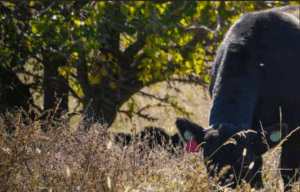

Finding a dead calf on pasture is never pleasant.
The lost value of the calf and the logistics of retrieval and disposal are bad enough.
But there is also the lingering question of what caused the death – and how many others might meet the same fate.
That question is sometimes hard to answer in grazing settings.
Expansive pastures make it a challenge to check every animal every day.
Warm summer temperatures and predators affecting the carcass can cloud a veterinarian’s ability to identify the tell-tale lesions that solve the mystery.
In addition, there are a lot of potential causes of sudden death in calves on pasture, including lightning strikes, lead poisoning, respiratory disease, ruptured stomach ulcers, and blackleg.

Many producers are quick to write off blackleg as one of these possibilities.
Blackleg is one of the oldest and most recognized causes of death in grazing calves, yet few producers have encountered cases – for reasons we will get to soon.
Blackleg progresses so rapidly once clinical signs appear that those signs are only very rarely noticed; dead calves are by far the most common presentation of this disease.
The culprit of this illness is a bacteria called Clostridium chauvoei.
An important feature of these germs is their ability to form spores, which are built to survive environmental extremes like heat and dryness.
These spores are found in many cattle environments, but it is on pasture that calves are most often exposed.
Calves eat the blackleg spores while they are grazing.
Those spores travel through the calf’s gut and are carried by white blood cells to muscle, where they lie dormant and might never cause any problem.
In certain calves though, when something happens to change the oxygenation of that muscle – a bruise, strenuous exertion, or stress, for example – the bacteria activate, multiply, and produce toxins.
Those toxins kill off the muscle tissue – which is bad enough – but they also travel throughout the body, shutting down the calf’s vital organ functions and causing a rapid death.

The muscle damage is about all the veterinarian has to go on when making a postmortem diagnosis in an affected calf.
Oftentimes the rear leg muscles will harbor an area of necrosis (tissue death) that appears dark brown, filled with gas pockets, and exudes a smelly redblack fluid.
Such a finding seals the diagnosis; the veterinary diagnostic lab can confirm it by growing Clostridium chauvoei from those tissues on a culture plate.
Sometimes, though, the damage caused by the blackleg bacteria can be much more subtle in the affected carcass.
The SDSU Animal Disease Research and Diagnostic Lab has documented more than a few blackleg cases where tissue damage is mild and hard to see.
This damage can affect the heart, the diaphragm, and the tongue (all of them muscle tissue, by the way).
Even subtle areas of damage can support enough growth of the bacteria and liberation of its toxin to kill the calf.
Decomposition out on pasture makes detecting these subtle lesions even harder.
A disturbing aspect of blackleg is that it often preferentially affects faster-growing, better-muscled calves; perhaps their muscles are more prone to the oxygen tension that sets off the chain of disease events.
For reasons mostly unknown, it is calves – not cows or bulls – affected by this disease.

Fortunately, blackleg is a very preventable problem.
Vaccines against the disease are numerous and effective. Most people know these as “7-way” or “8-way” vaccines that include protection against other members of the Clostridium family, such as overeating disease and tetanus.
Vaccinating calves prior to pasture turnout is a proven preventive method against blackleg; outbreaks are rare in vaccinated herds.
Vaccine labels carry instructions for giving a booster dose 3-6 weeks after the first administration; in certain problem pastures, this booster requirement could prove important.
The widespread use of these vaccines has made blackleg fairly uncommon nowadays.
Producers who do not regularly vaccinate calves for blackleg at the onset of the grazing season are essentially “rolling the dice,” as most pastures house the bacterial spores.
If you are in this category, it is a good idea to discuss a vaccination program with your veterinarian.
And scouting those pastures for the unfortunate – but hopefully rare – instances of calf death loss will help the chances you and your veterinarian can determine the cause.
 Russ Daly, DVM, MS, DACVPM (Epidemiology), is the Extension Veterinarian and a Professor in the Veterinary and Biomedical Sciences Department at South Dakota State University in Brookings, South Dakota. Dr. Daly practiced for 15 years and was a partner in a mixed-animal veterinary practice in Montrose, South Dakota, before joining the faculty at SDSU. The connections formed by Dr. Daly’s varied set of responsibilities – disseminating animal health information (gained through communications with practitioners, extension professionals, and laboratory diagnosticians), organizing veterinary continuing education, and teaching undergraduate, professional, and graduate students – allow him to uniquely serve professionals and citizens as a resource on animal and public health issues in South Dakota.
Get all Doc Talk episodes straight to your email inbox!